Ontario
Learn about the Frogs of Ontario
By participating in this program you will help to increase our knowledge of frogs and toads in Ontario. Frogs and toads are a part of local biodiversity - the amazing variety of life around us.
Starting in late March, participants in the FrogWatch Ontario Programme will be out in full force, listening for frog and toad calls in their local wetlands. Male frogs and toads will typically start to call in March in Southern Ontario and into April/May in Northern Ontario. Spring peepers, wood frogs, and chorus frogs are usually the first species to make their presence known in the spring, but larger frogs like the bullfrog may call as late as June/July. Each frog and toad species has its own distinct call, making it easy to recognize each of Ontario's 13 species.
Happy Listening!
Data provided by the Canadian Amphibian and Reptile Conservation Network

American Toad
Scientific name: Anaxyrus americanus
Classification: Toad
Description: The American Toad is a large, squat toad with warty brown, reddish or olive skin and variously coloured spots and skin glands. There is often a light line down the middle of the back. It is distinguished from other toads by its long parotid glands which do not touch its prominent cranial crests. Maximum adult size is 11 cm.

Fowler’s Toad
Scientific name: Anaxyrus fowleri
Classification: Toad
Description: Fowler’s Toad is a large yellow, green or brown toad with a light stripe down the middle of the back and large dark blotches. It has elongate parotid glands which contact its prominent cranial crests. Adults can reach up to 6 cm.

Northern (Blanchard’s) Cricket Frog
Scientific name: Acris crepitans blanchardi
Classification: Treefrog
Description: This rough-skinned treefrog may be greenish-brown, yellow, red or black. It is distinguished by a dark triangle between the eyes and relatively short legs. Maximum adult size is a mere 4 cm.

Spring Peeper
Scientific name: Pseudacris crucifer
Classification: Treefrog
Description: The Spring Peeper is a typical treefrog being small, with enlarged toe pads and varying in colour from tan to gray. It is distinguished from other treefrogs by a dark X on the back. These tiny frogs reach no more than 3 cm.

Western/Striped Chorus Frog
Scientific name: Pseudacris triseriata
Classification: Treefrog
Description: The Western Chorus Frog is a small, smooth skinned treefrog. Colour varies from green-gray to brown. There is a dark stripe through the eye and a white stripe along the upper lip. It is distinguished from most other treefrogs by the three dark stripes down the back. In some individuals the stripes are broken. Maximum adult size about 4 cm.
Boreal Chorus Frog
Scientific name: Pseudacris maculata
Classification: Treefrog
Description: The Boreal Chorus Frog is a small, smooth skinned treefrog. Colour varies from green-gray to brown. There is a dark stripe through the eye and a white stripe along the upper lip. It is distinguished from most other treefrogs by the three dark stripes down the back. In some individuals the stripes are broken into dashes or dots. Maximum adult size is just under 4 cm.
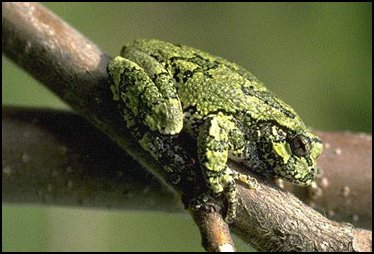
Gray Treefrog
Scientific name: Hyla versicolor
Classification: Treefrog
Description: The Gray Treefrog looks identical to Cope’s Gray Treefrog. The two species can only be distinguished from each other by their calls. They have rough, green, brown or gray skin with large darker blotches on the back. Like many treefrogs, they have large toe-pads. The two species can be distinguished from other frogs by the dark-edged light spot under the eyes and by bright yellow-orange colouration under the thighs. Adults may reach 6 cm.
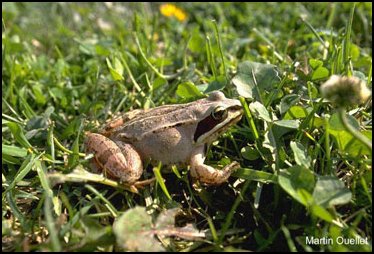
Wood Frog
Scientific name: Rana sylvatica
Classification: True Frog
Description: This is a moderate sized, true frog with prominent dorsolateral ridges. It may be reddish, tan or dark brown with a dark mask that ends abruptly behind the tympanum. Some individuals have a light line down the middle of the back. There is a dark blotch on the chest near each front leg. The belly is white and there may be some dark mottling. The toes are not fully webbed. Adults may reach up to 8 cm.
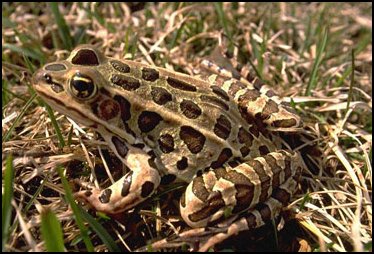
Leopard Frog
Scientific name: Rana pipiens
Classification: True Frog
Description: A green or brown frog with large, light-edged spots. Leopard Frogs also have prominent light-coloured dorsolateral ridges and a white belly. They can grow to over 10 cm body length but this is quite rare. Adults are usually 5-8 cm.

Pickerel Frog
Scientific name: Lithobates sylvaticus
Classification: True Frog
Description: This is a moderate sized, true frog with smooth tan skin. It has prominent yellow dorsolateral ridges and bright yellow on the belly and undersides of the hind legs. It is distinguished from other frogs by the parallel rows of dark, squarish spots down the back. Adults can grow to almost 9 cm.

Mink Frog
Scientific name: Lithobates septentrionalis
Classification: True Frog
Description: The Mink Frog is a moderate sized frog, olive to brown in colour and may have dark spots or mottling on the sides and hind legs. The belly is yellowish and the dorsolateral ridges may be prominent, partial or absent. It has a large tympanum and slightly upturned eyes. The name Mink Frog refers to its pungent, musky odour. The webbing on the hind foot reaches the last joint of the longest toe. Adults may reach 7 cm.
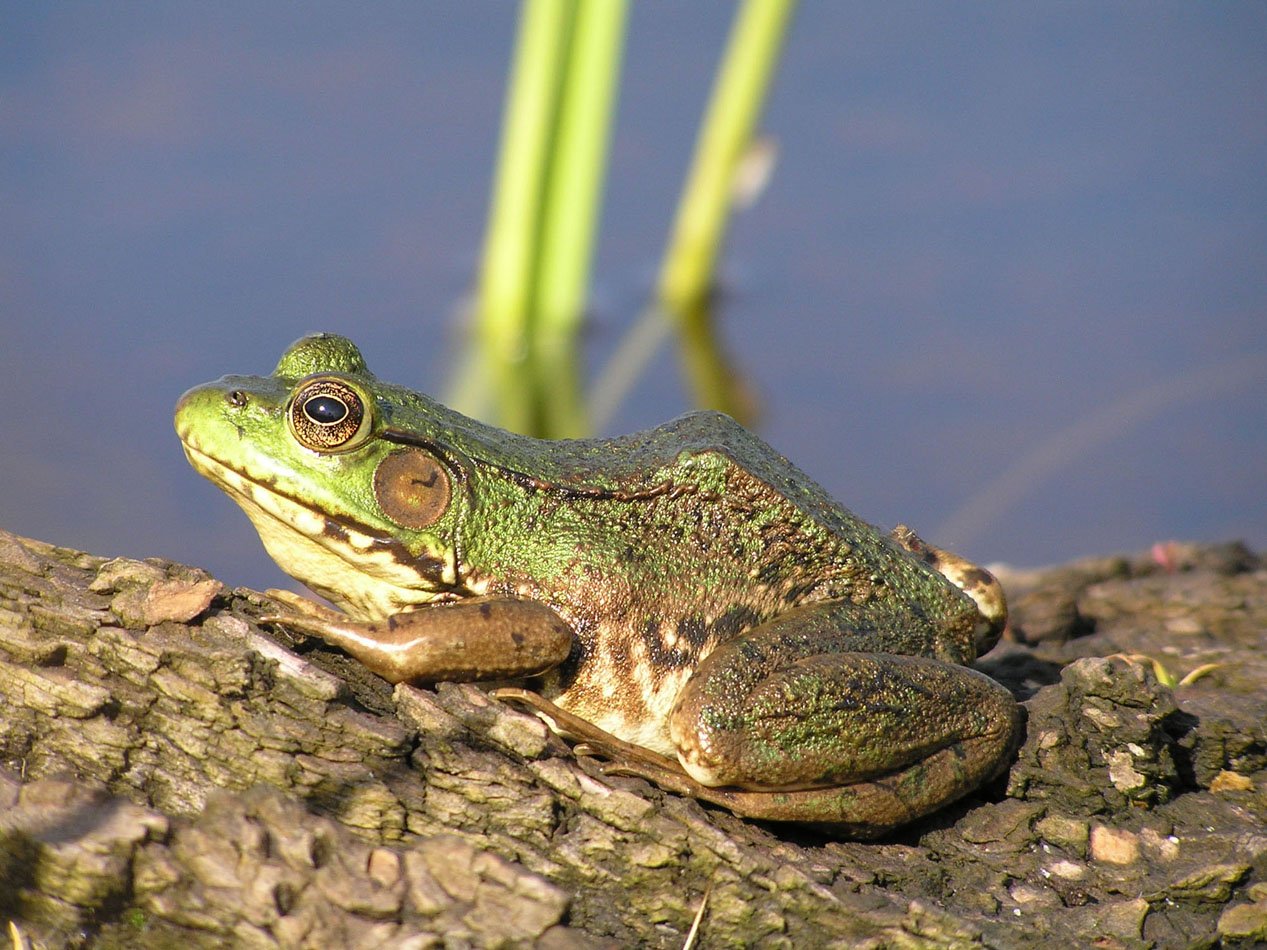
Green Frog
Scientific name: Rana clamitans
Classification: True frog
Description: The Green Frog is a large, true frog with large, distinct tympanum and prominent dorsolateral ridges. It may be green, bronze or brown, or a combination but is typically green on the upper lip. The belly is white with darker lines or spots. There may be some irregular spotting on the back. It is distinguished from other frogs in that the dorsolateral ridges run only partway down the back and do not reach the groin. The hind legs have dark bars. Males have a bright yellow throat. Maximum adult size is 10 cm.
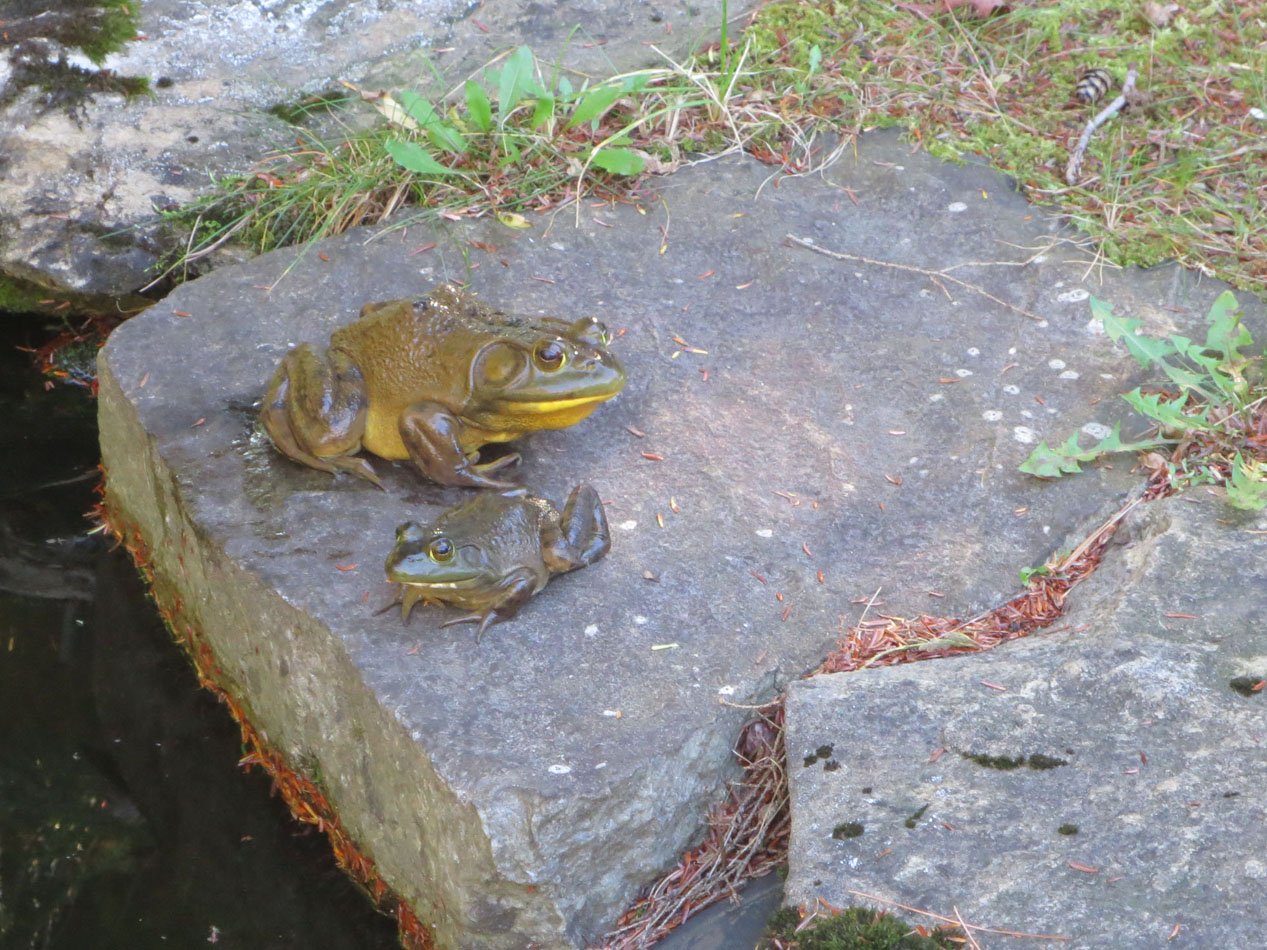
Bullfrog
Scientific name: Rana catesbeiana
Classification: True Frog
Description: The Bullfrog is the largest frog found in North America. Their tadpoles also grow larger than other species. The colour varies from pale green to dark greenish/brown above and is creamy white below with variable dark mottling on the back or underside. It is distinguished by its very large tympanum which is always larger than the eye, and by the lack of dorsolateral ridges. Adult males have pale to bright yellow chins during the breeding season. Adults may reach up to 17 cm long.