Saskatchewan
Learn about the Frogs of Saskatchewan!
By participating in this program you will help to increase our knowledge of frogs and toads in Saskatchewan. Frogs and toads are a part of local biodiversity - the amazing variety of life around us. Conserving biodiversity is essential to the health of the planet and the welfare of humankind. Frogs and toads also have a special role to play in keeping the environment healthy. Perhaps because they live "on the edge" between water and land, frogs and toads are very sensitive to pollution and other environmental changes.Happy Listening!
Frogs of Saskatchewan
Data provided by the Canadian Amphibian and Reptile Conservation Network
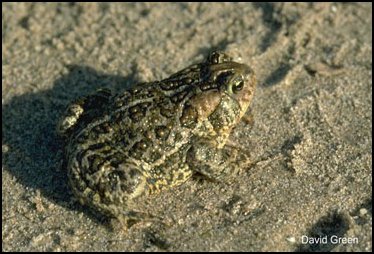
Canadian Toad
Scientific name: Anaxyrus hemiophrys
Classification: Toad
Description: This relatively small toad is either brown to grey-green or reddish with reddish warts surrounded by black spots. There is a light line down the centre of the back and the belly is pale with grey spots. It is distinguished by cranial crests which fuse to form a hump between the eyes. Two prominent tubercles on its hind feet are used for burrowing. Maximum adult size is only 7 cm.

Great Plains Toad
Scientific name: Bufo cognatus
Classification: Treefrog
Description: The Spotted Frog is a large brown true frog with ill defined spots which may have light centres. It has dorsolateral ridges and a dark mask with a light stripe on the upper jaw. Its toes are fully webbed and the eyes are slightly upturned. The tympanum is prominent. The underside may be yellow, orange or red with dark mottling on the throat. Maximum adult size is 10 cm.
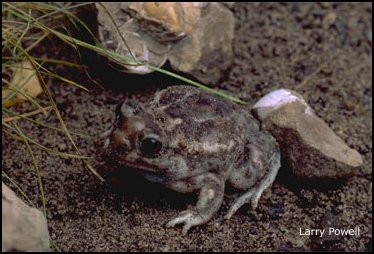
Plains Spadefoot Toad
Scientific name: Spea bombifrons
Classification: Toad
Description: Spadefoots differ from other frogs and toads by their vertical pupil, relatively smooth skin, teeth in their upper jaw and absence of parotid glands. They also have a horny, sharp, dark edged knob or tubercle (the “spade”) on the inner surface of the hind foot. There may be light stripes on the back. The belly is white. Maximum adult size is 6 cm.

Boreal Chorus Frog
Scientific name: Pseudacris maculata
Classification: Treefrog
Description: The Boreal Chorus Frog is a small, smooth skinned treefrog. Colour varies from green-gray to brown. There is a dark stripe through the eye and a white stripe along the upper lip. It is distinguished from most other treefrogs by the three dark stripes down the back. In some individuals the stripes are broken into dashes or dots. Maximum adult size is just under 4 cm.
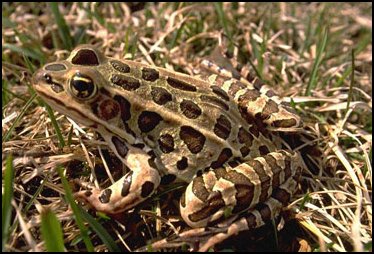
Leopard Frog
Scientific name: Rana pipiens
Classification: True Frog
Description: A green or brown frog with large, light-edged spots. Leopard Frogs also have prominent light-coloured dorsolateral ridges and a white belly. They can grow to over 10 cm body length but this is quite rare. Adults are usually 5-8 cm.
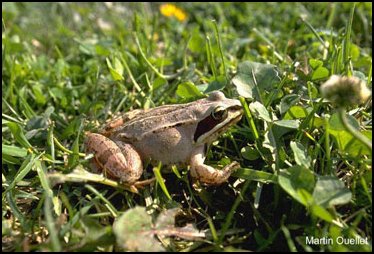
Wood Frog
Scientific name: Rana sylvatica
Classification: True Frog
Description: This is a moderate sized, true frog with prominent dorsolateral ridges. It may be reddish, tan or dark brown with a dark mask that ends abruptly behind the tympanum. Some individuals have a light line down the middle of the back. There is a dark blotch on the chest near each front leg. The belly is white and there may be some dark mottling. The toes are not fully webbed. Adults may reach up to 8 cm.